The Validity Trap: How Telecoms Punish Frugal Users
“I have Wi-Fi at home and at work. I barely touch mobile data. Why pay ₹3,500+ a year for 2GB/day I’ll never use?” That’s the pitch.
Except that premise is shakier than it sounds. “No data at all” is barely a real option in 2026 anyway. The moment you need to pay someone over UPI or open a banking app outside Wi-Fi range, zero data stops being a lifestyle choice and starts being a problem. Almost nobody actually gets to stay data-free; they just don’t know it yet when they go shopping for a plan.
But once you open your telecom operator’s app to recharge, and you’ll see dozens of plans. It looks like a marketplace. It isn’t. It’s a maze designed to funnel you toward exactly one outcome: the premium unlimited-data annual plan.
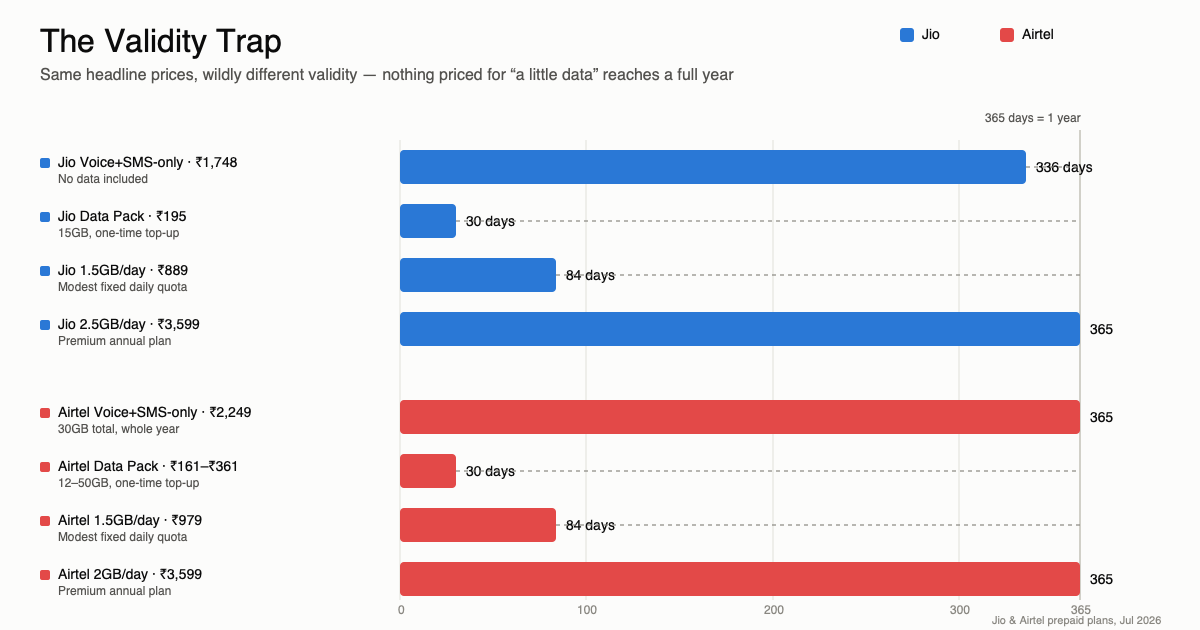
So you scroll down and find the answer that seems to be waiting for you: a cheap, voice-only annual plan. Jio offers one at ₹1,748 for 336 days. Airtel’s version is ₹2,249 for 365 days with a token 30GB thrown in for the whole year. It feels like a win. You’ve outsmarted the system.
You haven’t. You’ve just walked into the trap.
The Trap: A Validity Ceiling With No Exceptions
Here’s the flaw neither operator advertises: every data add-on pack (1GB, 2GB, 15GB, doesn’t matter) is capped at a maximum validity of 30 days. There is no 90-day pack. No 180-day pack. No way to buy a chunk of data that lasts as long as your annual voice plan does.
This isn’t an oversight. It’s the entire mechanism.
And it has a paper trail. The cheap voice-only plan itself only exists because TRAI forced telcos to offer one: a mandate ordering every operator to sell at least one voice-and-SMS-only voucher, specifically to stop the practice of force-bundling data into every recharge. Telcos complied, technically, and then out-maneuvered the regulator in the same move: they stripped data out of the mandated plan and pushed users toward a separate, expensive data plan instead.
The 30-day cap on data packs came after that, and it wasn’t always there. Data add-ons used to inherit “plan validity”: buy a pack, and it ran for as long as your base plan did, voice or otherwise. Ever since the TRAI-mandated voice-and-SMS voucher forced the frugal plan into existence, operators have been quietly severing that inheritance and tightening the cap further, one data pack at a time. The industry hasn’t restored it; it has only closed more of the gaps. TRAI, for its part, is now pushing for round two (mandating voice-and-SMS-only plans at every validity slab), and telcos are fighting that too.
This isn’t even the first time regulators have had to fight operators over validity math. For years, the default “monthly” plan wasn’t 30 days: it was 28, quietly turning 12 recharges a year into 13. TRAI eventually stepped in and ordered every operator to offer at least one plan, one special tariff voucher, and one combo voucher with a genuine 30-day validity in each category. Operators complied, in the narrowest possible sense: the mandated 30-day option now sits in the app alongside a full menu of 28-day plans, and the 28-day plans remain the default most people still recharge into. Same regulator, same playbook, same result: comply with the letter, keep the workaround as the path of least resistance.
The Math: Frugal Costs More
Jio. Take the ₹1,748 voice-only annual plan (336 days). Say you need a modest 15GB a month: nothing greedy, just enough to get by without Wi-Fi. That’s the ₹195/15GB pack. But it only lasts 30 days, so over 336 days you need to buy it roughly 11 times:
  ₹1,748  (voice-only annual plan)
+  ₹2,145  (11 × ₹195 data pack, re-bought every 30 days)
─────────────────────────────────────────────────────────
=  ₹3,893  to get through the year on "just enough" data
Jio’s premium annual plan with 2.5GB/day (vastly more data than you asked for) costs ₹3,599.
You paid ₹294 more to deliberately use less data, purely because the validity math was never designed to let you.
Airtel. Same story, different numbers. The ₹2,249/365-day voice plan bundles just 30GB for the entire year, nowhere close to 1GB a week. Burn through that (easy to do) and you’re topping up with data packs priced across the range: ₹161 for 12GB, ₹200 for 30GB, ₹361 for 50GB. It makes no difference which one you pick. Every single one caps out at 28 to 30 days validity. Buy the biggest pack Airtel sells and you still can’t make it stretch two months, let alone the rest of your annual voice plan. Try to cover a modest, consistent monthly need this way over 365 days and you sail straight past Airtel’s own premium annual plan at ₹3,599 for 2GB/day.
Two competitors. Same structure. Same result. That’s not a coincidence. That’s an industry standard.
And it isn’t only the emergency top-up packs that are boxed in. The “reasonable” daily-data plans are too. Jio sells a genuinely modest 1.5GB/day tier, priced well under the flagship annual plans:
- ₹239 for 22 days
- ₹299 or ₹329 for 28 days
- ₹579 for 56 days
- ₹889 for 84 days
Four validity tiers, and not one of them goes past 84 days. Airtel’s equivalent 1.5GB/day tier tops out the same way.
There is no annual version of the modest plan on either network. Want a fixed, sane daily quota that runs for a full year? That product doesn’t exist. You’re funneled to either the voice-only-plus-top-up treadmill or the 2GB+/day flagship, with nothing sized for the person in between.
Why: It’s ARPU Engineering
Telecom pricing teams don’t lose sleep over this. It’s a deliberate lever on ARPU (Average Revenue Per User), the single metric every quarterly earnings call obsesses over.
Picture the whole catalogue as a sandwich, and the strategy becomes obvious: the bread is there, the filling isn’t. On the bottom, there’s a barebones voice plan, cheap enough to look responsible, that functions as little more than a “keep-your-number-alive” holding pen. Use any real data on it and you’re punished immediately. On top sits a heavy daily-data plan, 1.5 to 2.5GB every single day, engineered to hand light users far more than they need at a price that guarantees healthy margins. In between, where a person who just wants some data reliably (without daily excess or monthly repurchase anxiety) would expect something to exist, there’s nothing. That gap isn’t an accident of product design. It’s the entire strategy. By making the à la carte, pay-for-what-you-use path administratively exhausting (track your usage, remember to recharge every 20-30 days, do it eleven separate times a year), operators bank on a simple behavioral outcome: consumers give up on optimizing and buy the expensive plan “for peace of mind.”
It is, genuinely, brilliant commercial engineering. It is also a calculated elimination of consumer choice, dressed up as a menu of options.
What Actual Choice Would Look Like
The fix is not complicated, which is exactly why its absence is telling. A data add-on whose validity simply matched the base plan’s remaining validity (buy 180GB once, use it across 180 days, at a fair per-GB rate) would let a genuine light user pay for what they use and nothing more.
Until regulators or competitive pressure force the issue, the lesson for consumers is blunt: in Indian telecom today, there is no such thing as a cheap plan for someone who uses “a little” data. There is only cheap-and-punished, or expensive-and-left-alone. The frugal middle has been engineered out of existence, and the receipt is right there in the math.
A note on scope: this piece looks only at Jio and Airtel, since together they set the market’s pricing playbook. Vi and BSNL aren’t covered here. BSNL in particular is worth a separate look, since it still undercuts on price.