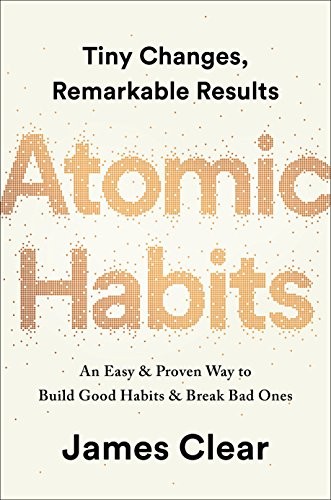
Atomic Habits — James Clear
Read: August 2026Probably the most recommended book in the habit-building space, and it earns that reputation. The core argument is simple enough to state in a sentence, and the rest of the book is just working out its implications: small, consistent changes compound into outcomes that look dramatic only in hindsight.
You don’t rise to the level of your goals, you fall to the level of your systems. Clear’s whole argument rests on this. Two people can share the same goal and get wildly different results because goals are just the desired outcome, systems are the process that gets you there. Winners and losers often have the same goals, the thing that separates them is what they do between now and then.
Habits are the compound interest of self-improvement. A 1% improvement isn’t noticeable, but a 1% decline isn’t either, and stacked daily over a year, 1% better compounds to roughly 37 times better while 1% worse compounds to nearly zero. The outcomes of any habit are rarely visible in the moment, which is exactly why they’re so easy to neglect.
Identity-based habits beat outcome-based habits. Instead of “I want to run a marathon,” the more durable frame is “I am a runner.” Every action is a vote for the type of person you want to become. The goal isn’t to read a book, it’s to become a reader. The goal isn’t to run, it’s to become a runner. Behavior that’s inconsistent with your self-image won’t stick no matter how good the system is.
The habit loop: cue, craving, response, reward. And the four laws that follow from it for building a good habit: make it obvious, make it attractive, make it easy, make it satisfying. Break a bad habit by inverting each one: make it invisible, unattractive, difficult, unsatisfying.
Make it easy is underrated. The two-minute rule stuck with me the most: scale any new habit down to something that takes two minutes or less. “Read before bed” becomes “read one page.” The point isn’t the two minutes, it’s removing enough friction that showing up becomes automatic, and once you’re showing up consistently, scaling the habit back up is the easy part.
Environment design beats willpower. Clear’s point is that you don’t need more discipline, you need a better-arranged room. Put the guitar in the middle of the living room if you want to practice more, put the phone in another room if you want to stop checking it. Most people try to change habits by fighting their environment, when it’s far easier to just redesign the environment so the right choice is also the obvious one.
The plateau of latent potential. Progress isn’t linear, most of the work happens below a surface that doesn’t show results until a threshold is crossed. An ice cube sitting at 25°F doesn’t visibly change as the temperature rises to 26, 27, 30, 31, it looks the same the whole time, until 32°F, where everything shifts. People quit in the plateau because the lack of visible progress feels like proof it isn’t working, right before the point where it would have.
What’s left isn’t any single tactic, it’s the reflex to ask “what system produced this outcome” instead of just setting another goal.