Bookshelf
Not book reviews. Just personal notes and mental models from books that changed how I think.
The Man Behind the Wheel — Tim Bouquet
Read: August 2026Subject: Onkar S. Kanwar (Apollo Tyres)
Core thesis: True industrial scale isn’t built by political networking alone; it requires operational resilience, geographical diversification, and bold global risk-taking during moments of crisis.
The 30-second core insight: Onkar Kanwar transformed Apollo Tyres from a single, union-plagued Indian factory into a $2B+ global giant by systematically decoupling production from local risk, professionalizing family leadership, and acquiring distressed global brands (Vredestein) long before Indian globalization was fashionable.
Key mental models:
| Pillar | The situation | Kanwar’s move | Universal lesson |
|---|---|---|---|
| Operational risk | Labor strikes paralyzed the primary Kerala plant in the 1980s | Built a second factory in Gujarat to break single-point-failure dependency | Never let a single operational bottleneck hold the enterprise hostage |
| Capital allocation | Operating under the restrictive pre-1991 License Raj | Acquired existing distressed licenses (Nirlon) rather than waiting | Find creative workarounds within rigid system constraints |
| Global expansion | Domestic price wars and commodity pressure | Cross-border M&A: bought Dunlop South Africa and Dutch brand Vredestein | Acquire premium R&D/brand equity in mature markets to upgrade margins |
| Leadership transition | Friction between relationship-driven father and systems-driven son | Fought for professionalized strategy over traditional patriarch control | Sentimental legacy must give way to institutional longevity |
The anti-fragile production principle: Labor union strikes threatened to bankrupt the single-factory Kerala operation. Rather than bowing to pressure, Kanwar used a multi-state footprint to hedge operational risk - “Apollo could not be held to ransom by unions.”
The global value step-up: moving from execution risk, to scale efficiency, to global R&D and margins.
Single factory (Kerala) → Multi-plant domestic (Gujarat/Chennai) → International M&A (Netherlands/Hungary)
The one that got away: Apollo came close to acquiring Cooper Tire for $2.5B in 2013 - bigger than Tata’s Jaguar Land Rover deal - and had already done much of the integration planning before it fell apart. Kanwar’s own framing of the failure: “You cannot regret, because everything happens for the best. Equally you cannot go forward if you are looking backwards. We didn’t look back. We said, ‘Let’s move on.’”
Quotes that stuck:
- “Onkar Singh Kanwar only knows one direction and that is forward. Whatever life throws in your path, you carry on, you stand on your own two feet and you follow your dream.”
- “The basic principles do not change when you become big but I remind the HR people that they must listen to staff. As I keep saying, listening is learning.”
- “A tyre is a unique combination of steel and rubber. The steel withstands the stresses placed on a tyre and the rubber takes care of the strain.”
- On punctuality: “Onkar is equally wedded to punctuality. To him turning up late shows lack of respect and lack of intent.”
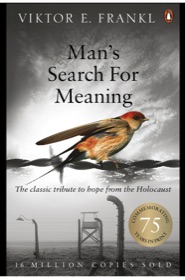
Man's Search for Meaning — Viktor E. Frankl
Read: July 2026I picked this up looking for some kind of answer on what the purpose of life actually is. It gave me one, just not the kind I expected: a firsthand account of what life looks like when there’s no real hope left, and how meaning can still survive in that space. Short, dense, and worth the reread every few years.
Stop asking what you want from life. Ask what it wants from you. This is the pivot the whole book turns on. “It did not really matter what we expected from life, but rather what life expected from us. We needed to stop asking about the meaning of life, and instead to think of ourselves as those who were being questioned by life, daily and hourly. Our answer must consist, not in talk and meditation, but in right action and in right conduct. Life ultimately means taking the responsibility to find the right answer to its problems and to fulfill the tasks which it constantly sets for each individual. These tasks, and therefore the meaning of life, differ from man to man, and from moment to moment… No situation repeats itself, and each situation calls for a different response… When a man finds that it is his destiny to suffer, he will have to accept his suffering as his task, his single and unique task. He will have to acknowledge the fact that even in suffering he is unique and alone in the universe. No one can relieve him of his suffering or suffer in his place. His unique opportunity lies in the way in which he bears his burden.”
Success isn’t a target. “Don’t aim at success, the more you aim at it and make it a target, the more you are going to miss it. For success, like happiness, cannot be pursued; it must ensue, and it only does so as the unintended side effect of one’s dedication to a cause greater than oneself or as the by-product of one’s surrender to a person other than oneself.” I’ve seen this play out in my own career. The stretches where I was fixated on the next promotion or the next milestone were rarely the stretches where anything good actually happened. The good stretches were the ones where I was just absorbed in solving a real problem.
A reason beats a method. “He who has a why to live for can bear with almost any how,” Nietzsche’s line, and Frankl adopts it as his own guiding principle for working with prisoners. It’s a simple reframe but a useful one: when something is hard, the fix usually isn’t a better technique for enduring it. It’s finding or remembering the reason you’re doing it at all.
Where meaning actually comes from. “According to logotherapy, we can discover this meaning in life in three different ways: (1) by creating a work or doing a deed; (2) by experiencing something or encountering someone; and (3) by the attitude we take toward unavoidable suffering.” That third one is the part most self-help skips. You don’t always get to choose your circumstances, but you get to choose what you make of them.
Trying to sleep is what keeps you awake. Fear of not sleeping creates a hyper-focus on falling asleep, which is exactly what prevents it. Frankl’s fix for patients was almost mischievous: stop trying to sleep, and instead try to stay awake as long as possible. The anxiety that was blocking sleep loses its grip once you stop fighting it head-on. I think about this every time I catch myself trying too hard to force an outcome that anxiety is standing in the way of.
Circumstances don’t decide who you are. In the camps, Frankl watched people with the same starting conditions turn out completely differently, some acting like saints and some like swine. His conclusion: man is ultimately self-determining. What you become, within the limits of what you’re given, is something you make of yourself. Decisions, not conditions. He kept coming back to the men who walked the camp huts comforting others and giving away their last piece of bread, few in number, but proof of something: everything can be taken from a person except one thing, the freedom to choose an attitude in any given circumstance. Every other freedom can be stripped away. That one can’t.
Love doesn’t need the other person present. Marching through the snow, not knowing if his wife was even alive, Frankl held on to her image anyway. “My mind still clung to the image of my wife… Love goes very far beyond the physical person of the beloved. It finds its deepest meaning in his spiritual being, his inner self. Whether or not he is actually present, whether or not he is still alive at all, ceases somehow to be of importance.”
Naming an emotion drains it. He quotes Spinoza on this: emotion that is suffering stops being suffering the moment we form a clear and precise picture of it.
Nietzsche’s line, tested for real. Was mich nicht umbringt, macht mich stärker - what doesn’t kill me makes me stronger. Frankl earned the right to quote it. Whatever we survive becomes something we can draw on later, not just a wound to carry.
Frankl kept circling back to the same core idea from different angles: through Spinoza, through Nietzsche, through his own clinical work. The proof isn’t in the argument, it’s that he lived it and came out the other side still able to write this book.