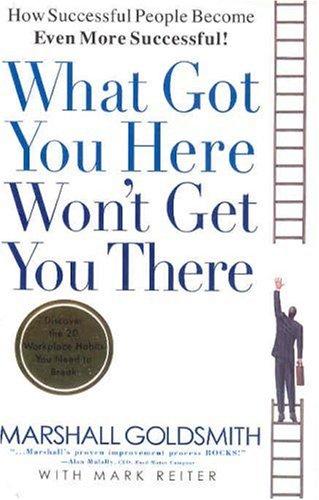
What Got You Here Won't Get You There — Marshall Goldsmith
Read: October 2026A book about success not scaling the way we assume it does. The habits that got you promoted aren’t the ones that keep working at the next level, and past a certain point, the only real lever left is behavioral.
Keep a “stop doing” list, not just a “to do” list. Goldsmith’s central move: most self-improvement focuses on what to add, but the highest-leverage change is often just stopping something. “If he had simply stopped what he was doing, his reputation and net worth might have remained intact.” Stopping a behavior gets no credit and no attention, but it can matter as much as everything else combined.
We misjudge ourselves in both directions. People overestimate their strengths and overrate their weaknesses. Ask a team to estimate their percentage contribution to a project and the total always runs past 100%. Everyone’s playing a “what’s in it for me” calculus on every choice, including the ones they’d never frame that way out loud.
Truth isn’t the bar for saying something. “The fact that a destructive comment is true is irrelevant. The question is not, ‘is it true?’, but rather, ‘is it worth it?’” Most of what undermines us socially isn’t willful. Being bad at sharing information isn’t the same as withholding it, and paying attention to what we actually say is the clearest signal of what’s turning people off.
Feedback vs. feedforward. Feedback reports on the past, which you can’t change. Feedforward is the same information aimed at the future, ideas you can actually act on. If you’re soliciting feedback for yourself, Goldsmith says there’s really only one question that works: “How can I do better?” Not “what did I do wrong,” not “how was I perceived.” Just that.
It’s not what you say, it’s what they hear. Feedback tells you what to change, not how. The “how” is the real work, and transformations here take time to register with the people assessing you: “You have to change 100% to get 10% credit for it.”
Recognition is underrated and resentment is sticky. Of all the interpersonal slights people carry, not getting credit may be the one that lingers longest. Goldsmith’s fallback advice for handling any suggestion you don’t know how to respond to: just say thank you. When someone offers you an idea, you’re either going to learn more or learn nothing, never less.
“Marshall emphasizes gratitude a lot throughout the book. In this era, you could probably write most of it as LinkedIn recommendations.”
You don’t need all 39 attributes, just the few that are actually broken. No executive embodies every trait on a list of successful behaviors, and that’s fine. The real question for any gap: is it bad enough to merit fixing? If not, leave it alone.
“The same logic applies to professional goals generally: pick where you actually want to excel instead of trying to be well-rounded everywhere.”
Stop blaming others, especially for the choices that worked out. Understanding the past is fine if your problem is accepting it. If your problem is changing the future, understanding doesn’t get you there. We can’t see in ourselves what’s obvious to us in others, which is exactly why this stuff needs someone else pointing it out, and why it stings when they finally do. Goldsmith’s line on that sting: we need the painful, unsolicited feedback moments, because without the discomfort we might never find the motivation to change.
The 20 habits that hold successful people back. These aren’t character flaws, they’re transactional: one person doing something to another. The list, in full, because it’s worth having on hand rather than just a page reference:
- Winning too much: needing to win at all costs, even when it doesn’t matter.
- Adding too much value: the overwhelming urge to improve on every idea someone brings you.
- Passing judgment: rating others and imposing your own standards on them.
- Making destructive comments: needless sarcasm dressed up as being sharp or witty.
- Starting with “No,” “But,” or “However”: qualifiers that secretly say “I’m right, you’re wrong.”
- Telling the world how smart we are: needing to prove you’re smarter than people think.
- Speaking when angry: using emotional volatility as a management tool.
- Negativity, or “let me explain why that won’t work”: sharing negative thoughts even when nobody asked.
- Withholding information: refusing to share in order to maintain an advantage.
- Failing to give proper recognition: the inability to praise and reward.
- Claiming credit that we don’t deserve: overestimating our contribution to any success.
- Making excuses: recasting annoying behavior as a permanent trait so people excuse it.
- Clinging to the past: deflecting blame onto past events and people, a subset of blaming everyone else.
- Playing favorites: failing to see that you’re treating someone unfairly.
- Refusing to express regret: not taking responsibility, admitting fault, or recognizing how your actions land on others.
- Not listening: the most passive-aggressive form of disrespect toward colleagues.
- Failing to express gratitude: the most basic form of bad manners.
- Punishing the messenger: attacking the innocent person who was only trying to help.
- Passing the buck: blaming everyone but ourselves.
- An excessive need to be “me”: exalting our faults as virtues simply because they’re who we are.