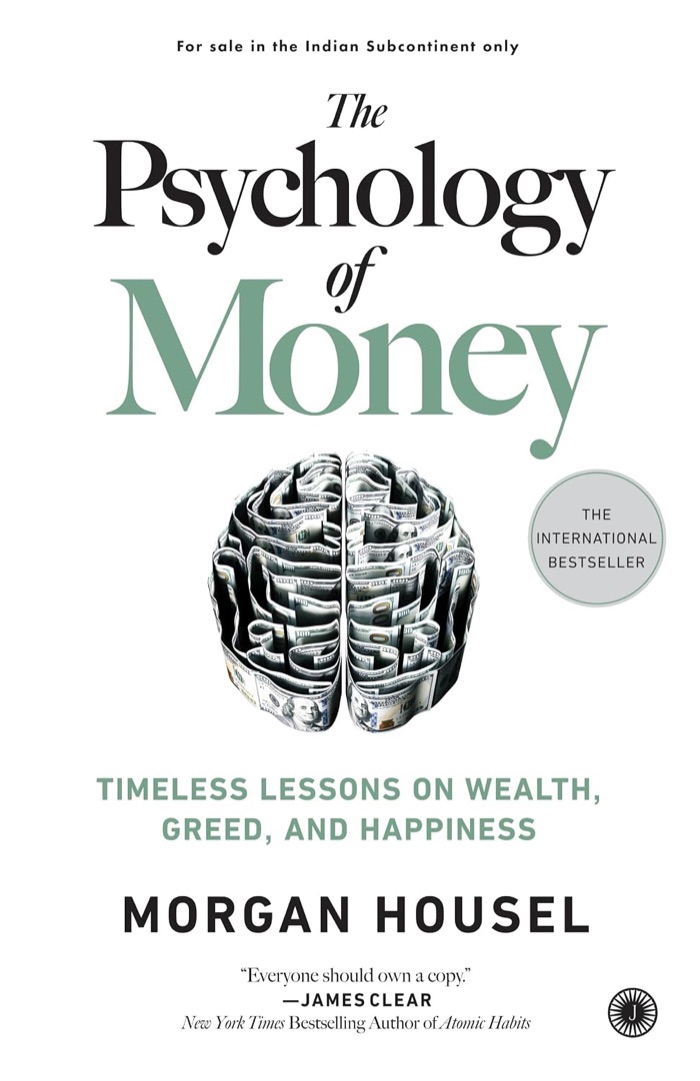
The Psychology of Money — Morgan Housel
Read: November 2026Morgan Housel’s argument is that how you behave with money matters more than how much you know about it. The book is a set of short essays on luck, risk, greed, fear and enough, and there’s hardly a formula in it. Knowing what to do tells you nothing about what happens in your head when you try to do it.
Luck and risk are cousins. Every outcome is shaped by forces other than individual effort, and it’s hard to tell which part of a result was skill, which was luck and which was risk. The line that stayed with me: if you accept that luck brought you success, you have to accept that risk can turn the story around just as quickly. Not all success is hard work, and not all poverty is laziness.
Enough. Joseph Heller’s reply, when told a billionaire made more in a day than Heller’s best-selling novel ever had, was that he had something the man would never have: enough. There’s no reason to risk what you have and need for what you don’t have and don’t need. The hardest financial skill is getting the goalpost to stop moving.
Survival beats returns. Getting money takes risk, optimism and putting yourself out there. Keeping it takes the opposite: humility, and fear that it can be taken from you as fast as it came. Buffett’s skill is investing, but his secret is time. Housel would rather be financially unbreakable than chase big returns. Cash that keeps you from selling stocks in a bear market earns far more than its 1% yield suggests.
Room for error. A plan is only useful if it survives reality, and reality is full of unknowns. If your savings rate works even when the market returns 4% instead of 8%, the plan is worth something. Graham called it the margin of safety, there to make the forecast unnecessary. The book’s example is Germany keeping its tanks ready in the field for months, and when the time came, nothing worked. Field mice had chewed through the wiring insulation. (Outside the book: field mice did chew through wiring in idle tanks on the Eastern Front, most famously near Stalingrad in late 1942, though historians debate how widespread or decisive the damage was.) No tank designer plans for mice, which is why you want slack for the things you can’t imagine. Related: a single point of failure will eventually fail.
Tails drive everything. Almost everything huge or famous comes from a one-in-thousands event. Buffett has owned 400 to 500 stocks and made most of his money on about ten. A good stock picker is right maybe half the time, and you can be wrong half the time and still make a fortune. Judge yourself on the whole portfolio, not on individual positions. Uncertainty, doubt and regret are fees, not fines.
Wealth is what you don’t see. Rich is current income. Wealth is income not spent, so it’s invisible by nature. Spend on things and you end up with the things and not the money. The highest dividend money pays is the ability to do what you want, when you want, with whom you want, for as long as you want. Flexibility is also a better edge than intelligence.
Be reasonable, not rational. You’re not a spreadsheet, you’re a person. Aiming to be coldly rational is unrealistic. Aiming to be pretty reasonable is something you can stick with, and sticking with it is what matters.
History is a bad guide to specifics. Greed, fear and how people behave under stress stay stable over time. Specific trades, sectors and rules of thumb don’t. The 401(k) is only 42 years old, so retirement advice isn’t comparable to what made sense a generation ago. Housel stays mostly with the US, but the point travels. In India we had the EPF, and then the NPS came along (2004 for new government recruits, 2009 for every citizen), so what a salaried person should do about retirement has changed within one working life here too. Surprises are the most common plot in economic history, and failing to foresee them is a failure of imagination, not analysis. Housel’s treatment of hindsight, via Kahneman, is worth reading on its own: explaining the past gives us the illusion that the world makes sense.
Different games. Ask what a fair price for Google stock is and the answer depends on who “you” is. A day trader doesn’t care whether it’s $5 or $500 as long as it moves the right way that day. Prices that look ridiculous to one investor make sense to another, so define your own game and don’t let people playing a different one influence you. Also: pessimism sounds smarter than optimism, and progress is too slow to notice while setbacks are too fast to ignore.
Confessions. This was the chapter that got me. Housel writes that owning their house without a mortgage was the worst financial decision and the best money decision they ever made. Good decisions aren’t always rational. At some point you choose between being happy and being right. He also admits that in his 20s he held around 25 individual stocks, and today nearly all of the family’s net worth is a house, a checking account and some Vanguard index funds. His strategy doesn’t depend on picking sectors or timing recessions. It depends on a high savings rate, patience and optimism that the global economy will create value over decades. And he’s changed strategy before, so he might again.
I recognised myself in all of it. I started with individual stocks too, and I once foreclosed a housing loan with a work bonus instead of investing it elsewhere. It’s the same trade Housel describes: not the optimal move on paper, but one I’d make again. I haven’t gone entirely to mutual funds, but I do index investing and I’m bringing the stock count down, as I wrote about in Money Has No Memory. Housel’s line that you should always do whatever maximises sleeping well at night is the one I keep returning to.
The Kahneman bit on startups ties back to The Nvidia Way: a company’s outcome depends as much on competitors and market changes as on its own effort, and Nvidia’s story is partly a story of luck and timing that looks like skill in hindsight.
Much of what makes sense for money makes sense for life in general: leave room for error, stay in the game, and know what is enough.