Money Has No Memory: Pruning My Portfolio
I started direct stock investing in 2013. Like every investor, I tried sticking to the basics: buy quality, diversify sensibly, let compounding do the work. My philosophy has been buying stocks of companies making products I use or buy. Occasionally, I also bought them based on what I read or the company’s leadership. I also attempted to spread risk by buying two companies of sectors I had invested in, e.g., two bank stocks instead of one! But just like most portfolios after a few years, mine was no longer a lean, well-oiled engine. A pile of accidental bets had taken over: satellite positions bought on a whim, cyclical laggards I wanted to be rid of, cash scattered across redundant instruments, and demergers I never asked for, like Tata Motors splitting into TMPV and TMCV, or ITC spinning off ITC Hotels, that left me holding miniscule slices of businesses I hadn’t actually chosen to own.
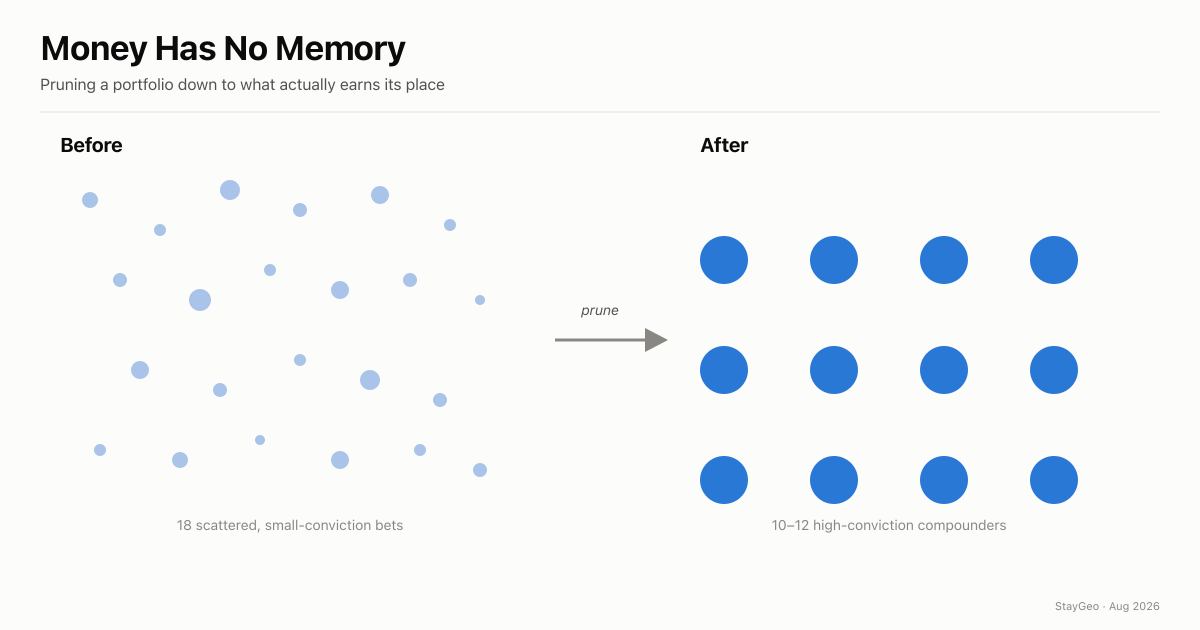
I started the exercise of pruning my own holdings recently, consolidating everything into a focused, high-conviction core. The hard part wasn’t the analysis. The numbers are easy enough to run. What’s hard is dismantling the behavioral traps that kept me holding on to positions that I might think twice before buying today.
Here are the ideas that got me through it.
🔗Money Has No Memory
The most dangerous price on your screen is the one you paid for the stock.
The market doesn’t know your purchase price, and your capital doesn’t care whether its next 9% comes from the stock that already lost you money or from a completely different business. When I’m evaluating a lagging position now, I ask one question: if I had this exact amount in cash right now, would I buy this stock today?
If the answer is no, holding on to it because I already own it isn’t a strategy. It’s anchoring bias wearing a strategy’s clothes. Selling isn’t admitting defeat. It’s freeing up capital to go where its forward return is actually highest.
🔗The Ghost of “What If It Becomes the Next Infosys or Eicher Motors?”
Right before you hit sell, a familiar thought shows up: what if this turns into the next Eicher Motors, or Infosys, or MRF, trading at ₹1 lakh a share five years from now? What if it rallies right after you swap it for something safer, and the safer one dips 15% the same week?
That’s outcome bias dressed up as caution, and it’s worth naming for what it is before it talks you out of a sale.
A company doesn’t become an Infosys or an Eicher Motors by luck. It takes sustained high return on capital, real pricing power, and decades of reinvestment runway. If the position you’re trimming doesn’t show those traits today, holding it on the chance that it develops them later is a lottery ticket, not an investment, and it dilutes the rest of the portfolio while you wait for the ticket to pay off.
Both stories get repeated because they’re real, not folklore. Infosys listed in 1993, and a series of bonus share issues and a stock split over the following two decades multiplied an early investor’s original shareholding many times over, well before the price itself did the rest of the work. That’s where the “driver of an early Infosys employee became a crorepati” stories come from. Eicher Motors is the more recent version: a stock trading around ₹2 in 2001 crossed ₹32,000 at its 2018 peak, turning a modest bet into crores for whoever held through nearly two decades of a two-wheeler business quietly compounding. Neither happened because someone got lucky and held on. Both companies spent close to twenty years earning high returns on capital before the price caught up.
The regret math also runs the other way from how it feels in the moment. Holding a mediocre business for years on the hope it turns around costs far more, in money and in attention, than missing an occasional bounce right after you sell. And the compounders you’re upgrading into aren’t just offense. A durable, high-quality core protects you on the way down too, when the market turns and the speculative names get hit hardest.
🔗Three Exits: Lottery Tickets, Cyclicals, and Satellites
A common assumption is that a cleanup only happens when you’re bleeding red ink. In my case, only one of these three positions was actually sitting in a loss. The other two were profitable exits, upgraded rather than abandoned. Each was addressing a different psychological trap, not a shared one.
| Category | The stock | Realized state | The rationale I was holding onto | What I did instead |
|---|---|---|---|---|
| The lottery ticket | Vodafone Idea | Loss | It’s only a few rupees a share, what if the turnaround happens and it triples | Exited entirely. The loss offset gains from the two profitable exits below instead of sitting around as unrealized hope. |
| The cyclical | Tata Motors CV | Profit | Commercial vehicle cycles will turn again, just ride it out | Swapped into ICICI Bank, locking in the gain and trading cyclical earnings for a high-ROE compounder. |
| The high-multiple satellite | Tata Communications | Profit | Enterprise data and CPaaS are the future | Swapped into Reliance Industries: from a ~45x+ P/E niche B2B play to a diversified conglomerate at ~23x P/E, near a multi-month consolidation level. |
None of these were calls that the company being trimmed was bad. Each was a call about capital efficiency: money sitting in a speculative hope or a cyclical laggard is fuel the core positions don’t get.
One clarification on that Tata Motors row: I didn’t buy Tata Motors CV directly. It landed in my portfolio when Tata Motors demerged into two separately listed entities, Tata Motors Commercial Vehicles and Tata Motors Passenger Vehicles. I exited the CV allotment for the cyclical reasons above, but I’m still holding, and actually adding to, Tata Motors Passenger Vehicles. That’s a different bet: I believe in its combined ICE-plus-EV lineup, and the sales numbers have backed that up so far. Trimming CV wasn’t a verdict on Tata Motors as a group, just on the cyclical half of it.
🔗The Breakeven Trap
Perhaps a middle-class trait, loss aversion runs deep enough that we hate booking a loss far more than we enjoy an equivalent gain. That’s what creates the breakeven trap: the urge to hold a mediocre stock just until it crawls back to zero P&L, so you can exit “without losing anything.” And I have held some of them for 5+ years in this hope while thanking myself that I did not have more than ₹25k stuck in such scrips!
What that reasoning skips over is the price tag on time. Holding a sluggish business for 18 months to recover an 8% dip ties up capital that could have compounded at 12-15% somewhere else. And under capital gains tax rules, realizing a small loss can actually work in your favor by offsetting gains you’ve booked elsewhere. Waiting for breakeven on a thesis that’s already dead doesn’t protect capital. It bleeds opportunity cost, quietly, for as long as you wait.
🔗The Math: How Loss Harvesting Actually Works
A big psychological barrier to selling a laggard is the fear of “booking a loss.” But once you understand the tax mechanics, taking a loss on a poor performer stops being a defeat and becomes a deliberate risk-management tool.
Every realized gain and every realized loss in a financial year nets out into a single number, and it’s that net figure your tax rate applies to, not each individual trade.
🔗The Set-Off Rules
These now sit under the Income Tax Act, 2025, which took effect this tax year and renumbered the provisions that used to live in the old 1961 Act. The mechanics haven’t changed, just the section numbers.
- A short-term capital loss (STCL) can offset both short-term capital gains (STCG) and long-term capital gains (LTCG), under Section 108.
- A long-term capital loss (LTCL) can only offset long-term capital gains (LTCG), not short-term gains, also under Section 108.
- If losses exceed gains in a given year, the unabsorbed loss carries forward for up to 8 tax years under Section 111, as long as you file your ITR on time. (These sit where Sections 70 and 74 used to, under the old Act, back when it was 8 assessment years instead.)
🔗A Hypothetical Case: Short-Term
| Position | Trade Type | Holding Period | Realized P&L |
|---|---|---|---|
| Stock A (profitable exit) | Sold for profit | < 12 months (STCG) | +₹50,000 |
| Stock B (pruned laggard) | Sold at a loss | < 12 months (STCL) | -₹20,000 |
| Net taxable STCG | ₹30,000 | ||
| Tax owed (20%) | ₹6,000 |
Without the loss, ₹50,000 taxed at 20% is ₹10,000. With it, the bill drops to ₹6,000. The loss on Stock B saved ₹4,000 in tax, on top of getting a dead position off the books.
🔗The Same Math, Long-Term
The rules work the same way for long-term positions, just with LTCG instead of STCG.
| Position | Trade Type | Holding Period | Realized P&L |
|---|---|---|---|
| Stock C (profitable exit) | Sold for profit | > 12 months (LTCG) | +₹2,00,000 |
| Stock D (pruned laggard) | Sold at a loss | > 12 months (LTCL) | -₹40,000 |
| Net taxable LTCG | ₹1,60,000 | ||
| Tax owed (12.5%, after ₹1.25L exemption) | ₹4,375 |
Listed equity LTCG is taxed at 12.5% (no indexation), with the first ₹1.25 lakh of gains in a financial year exempt. On a ₹1,60,000 net gain, ₹35,000 is taxable, for a bill of ₹4,375. Without harvesting the loss on Stock D, the ₹2,00,000 gain from Stock C alone would have left ₹75,000 taxable after the exemption, for a bill of ₹9,375. The loss saved ₹5,000 in tax.
🔗How This Actually Played Out
Of the three exits above, Vodafone Idea was the only one sitting in a loss, a little over ₹9,000. Tata Motors CV and Tata Communications were both sold at a profit.
Under Section 108, that ~₹9,000 loss was set off directly against the gains from those two profitable exits before any tax was calculated, so I owe tax on the net gain, not the gross. Had the year’s gains not been enough to absorb the loss, the unused balance would simply have carried forward under Section 111 instead of going to waste.
That’s a real case against the breakeven trap. The loss on a dead position isn’t just a write-off, it’s a lever you can pull to reduce what you owe on the winners you’re already holding.
🔗Don’t Penny-Pinch on the Order Book
When executing a multi-year portfolio upgrade, a classic rookie mistake is fighting the order book over pennies. Trying to save 0.2% on a limit order for a liquid large-cap risks missing the fill entirely if the stock moves in the afternoon session. If the thesis is to hold a high-compounding business for the next three to five years, arguing over ₹5 on the order price misses the point of the trade. When the goal is structural reallocation, certainty of execution matters more than shaving the last bit off the price.
When I ran the swap, I executed both the buy and sell legs directly at market price. The certainty of completion was worth far more than fighting for a few paise, and I could focus on other important things at hand.
🔗The Tax Friction Myth
The other kind of paralysis is tax related. A lot of us freeze at the thought of a 30% slab rate on debt fund gains, or start obsessing over STT and DP charges on every trade. Neither holds up once you look closely.
Micro charges like DP fees and turnover costs are rounding errors on a trade that’s actually worth making. And tax is charged on the gain, not on the principal, so the amount at stake is usually far smaller than it sounds in your head. Paying a small, unavoidable tax to move idle or inefficient cash into something that compounds at equity rates beats letting that capital sit still out of fear of the tax bill.
🔗Small Positions Are a Tax, Not a Hedge
A portfolio with 1-2% allocations scattered across half a dozen speculative stocks or redundant funds looks diversified. It isn’t, it’s just friction. A 1% position doubling barely moves the total portfolio. And the mental cost is real: you still track its quarterly results, check its daily ticks, and remember its tax lots at year-end, for a position too small to matter.
Ten to twelve high-conviction compounders, backed by broad index exposure, gave me cleaner risk management and a lot less to track than the pile of small positions ever did.
🔗Why the Best Holders Weren’t Paying Attention
The legendary 100-bagger stories, Wipro, MRF, the early Infosys shareholders, share a pattern that rarely gets mentioned. Almost nobody who watched the stock every day held it for twenty years. The people who actually captured the full return were usually the ones holding a physical share certificate in a cupboard, an old family holding nobody actively managed, or an account nobody logged into for a decade.
The reason isn’t complicated once you sit with it. Most multi-baggers spend three to seven years doing nothing while earnings quietly catch up to valuation. Someone watching a screen through years of flat, sideways trading experiences that stretch as failure and sells right before the next leg up. Someone with a paper certificate in a locker never saw those years happen at all, and never got the chance to interrupt the compounding.
| The active investor | The forgotten certificate | |
|---|---|---|
| Stock jumps 50% | “Lock in the profit,” sells early | Doesn’t know, still in the locker |
| Stock goes flat for years | “Dead money,” sells out of frustration | Doesn’t know, still in the locker |
| Company does splits and bonus issues | Reacts to every corporate action | Unopened mail, ignored |
| Twenty years later | Sold out long before the real move | Crorepati |
Physical certificates had another advantage nobody designed on purpose: friction. Selling meant finding the certificate, getting signatures verified, mailing a transfer deed to the registrar, and waiting weeks for a cheque. That friction wasn’t a flaw, it accidentally saved investors from their own worst instincts. A modern demat account removes all of that. A ten-year thesis can be undone in three taps, at 11 AM, on a red day.
Cleaning up a portfolio was never really about finding the next multibagger. It was about cutting the dead weight and letting the assets that are actually working compound without the distraction of the ones that aren’t. The next time I hesitate before hitting sell on a lagging position, I’ll remember that my capital has no memory of what I paid for it. Only of what I do with it next.
Update: what I did with it next is in I Set Rules to Buy the Dip. Then the Dip Came.
Disclaimer: None of this is financial advice. Just the frameworks that got me through my own cleanup.