I Set Rules to Buy the Dip. Then the Dip Came.
In August I started cutting my portfolio down to a short list. Then the market fell before I had finished, and that list went on sale.
It’s my first time doing this, so read it as a log rather than advice.
For years my investing was a monthly SIP plus the odd stock I bought when something felt cheap. “Felt cheap” was doing a lot of heavy lifting there. When prices actually fell, I did one of two things. I waited for them to fall a bit more and missed the rebound. Or I bought early, watched the price keep sliding, and had nothing left when it got properly cheap.
This year I tried something different. I wrote the rules down before I needed them.
🔗The setup
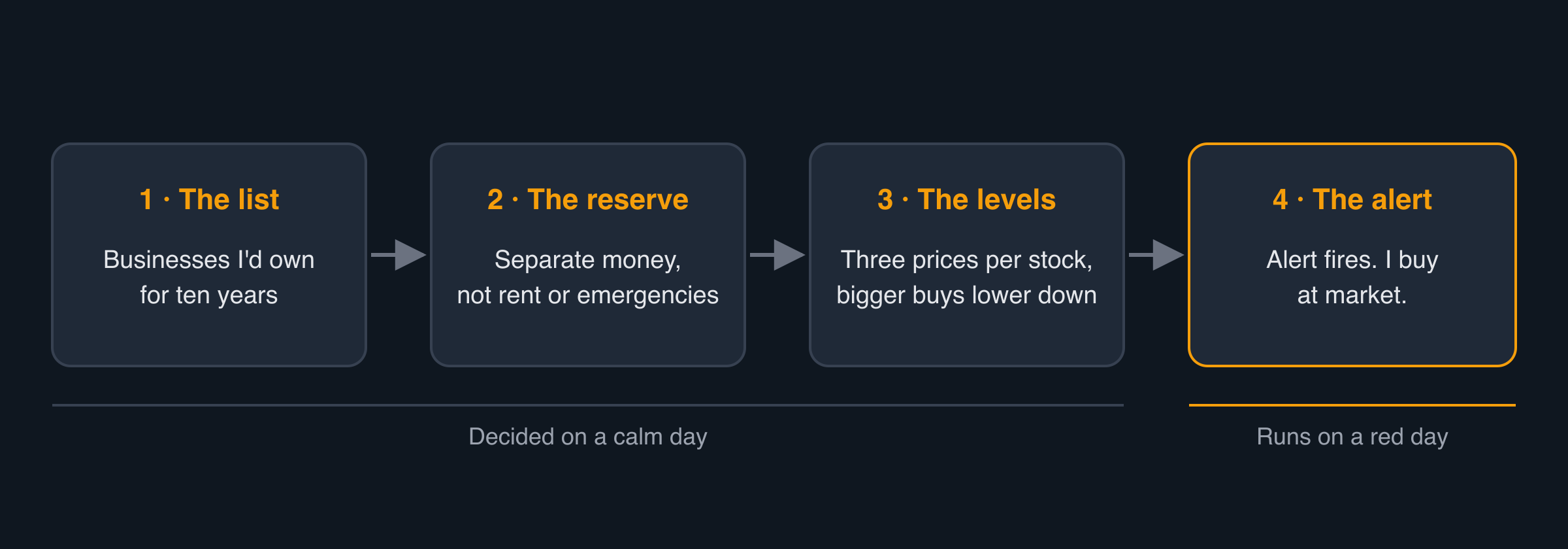
A short list, picked in advance. I chose a handful of businesses I would be happy to own for ten years. They earn high returns on capital, carry little or no debt, and lead their categories: FMCG, private banking, auto and market infrastructure. I made that call on a calm day, because a red day is the worst time to decide what’s good.
The list is where the pruning I wrote about in August is headed. That pruning isn’t done. I have given it 12 to 18 months, and the fall changed the order of things. Some of what I still plan to trim are good businesses, HDFC Bank among them, and I’m not going to sell them at crash prices just to stick to a timeline. That isn’t the anchoring I warned about in August. It has nothing to do with what I paid. Selling a good business at a crash price is just a bad trade. They can wait for a better exit. New money goes only to the list.
A separate pool of money. I maintain a reserve that exists only for these buys. It isn’t the family emergency fund and it isn’t next month’s credit card bill. If I have to wonder whether I can afford a buy, I won’t make it.
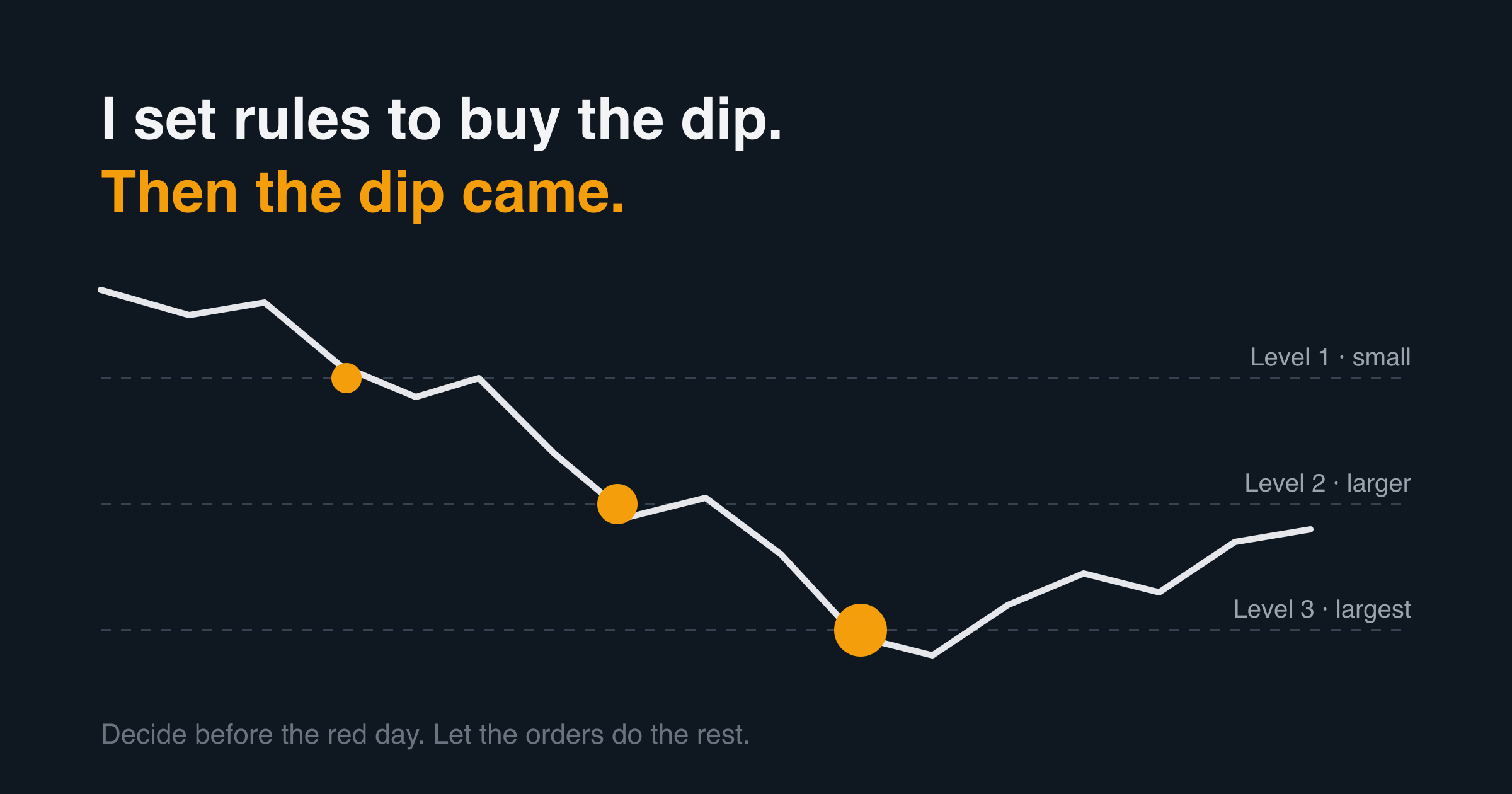
Price levels and sizes, fixed ahead of time. Each stock has three levels below its recent high: a starter level, a deeper one, and a “this is overdone” one. Each level gets a fixed, small amount, and the amount grows as the price drops. I sized everything so the reserve could cover all of it, even if every level got hit.
Plain alerts, market orders. I don’t trade from a phone. Each level is a simple price alert on Zerodha’s Kite, which emails me when the stock touches it. When one fires, I buy the planned amount at market from Kite on the web. The rule decides the level. Once it’s reached, I want the order filled, not haggled over.
I used an AI assistant to pressure-test the levels and sizing against the reserve.
🔗What actually happened
HUL, the slow grind. FMCG has been out of favour for months. HUL kept drifting lower without ever crashing. Left to myself, I would have either written it off as dead money or spent the whole allocation on the first small dip. The ladder made me do neither. I bought three tranches, each larger than the one before, as the price fell through my levels. My average now sits well below where my first instinct would have bought. Nothing exciting happened, and that was the idea.
Eicher, where the alert fired and I hesitated. Royal Enfield’s parent fell hard from its peak and my first alert went off. I did not act. I watched it slide further through the day before buying a small starter position, well below its high. It worked out, but I learned something uncomfortable. An alert doesn’t take the emotion away. It hands you the decision, and you still have to make it.
NSE, the issue price rule. I already held some from the IPO allotment. Instead of adding on listing-day excitement, I set one rule: buy more only if selling after listing pushed the price below the issue price. Flippers sold, the alert fired, and I added a tranche below the issue price, which brought my average cost down a little. It’s a rule I would use for any IPO I actually want to own.
SBI Card, the one I didn’t buy. It slid toward multi-year lows and looked cheap. I wanted it. But it’s an unsecured lender with rising credit costs, and it didn’t fit what I had written down for the list. So I passed. Having the list on paper turned out to be as useful for saying no as for saying yes.
A few days away. Alerts only work if you’re around to act on them. This week I was away, so for the first time I tried GTT (Good Till Triggered) orders instead: standing buy orders on five stocks from the list that Zerodha places by itself when a trigger price is hit. I checked that the cash in my trading account could cover all five if they fired together, and logged out. None of them triggered, so there’s no fill to report. But not having to watch anything while away was the most useful thing I tried in this whole exercise, and it’s where I would suggest anyone start.
🔗What I’m not claiming
I don’t know whether this was the bottom. The market could fall another 10%, go sideways for a year, or rally on Monday. If it keeps falling, my deeper levels trigger and I will have spent more of the reserve at lower prices. That is the plan. If it recovers, some levels never trigger and I’m left holding unspent cash. That’s also the plan.
I was never trying to hit the bottom. I was trying to stop making decisions while anxious.
A few things I would already change:
- My first levels were too shallow. A 5 to 7% fall in a large, good company is ordinary noise. Next time the first level goes further down.
- An alert price isn’t a fill price. By the time I open the email and place a market order, the price has moved. On a fast fall it may fill lower. On a sharp bounce I pay more. GTTs place limit orders instead, so a big gap down at the open can skip past the limit and leave the order unfilled.
- Write down why each stock is on the list. A couple of sentences per stock. When a holding is down 15% in a broad sell-off, that note is what stops you second-guessing the whole process.
🔗Setting this up on Kite
For anyone on Zerodha who wants to try the same thing (menus as of when I’m writing this):
- Alerts. On Kite web, open the stock from your watchlist and choose Create alert. Set the condition to last traded price less than or equal to your level. Name each alert with the stock, the level and the planned quantity, so the email tells you exactly what to do.
- GTT for time away. From the watchlist, choose Create GTT. Pick a Single trigger, Buy, and CNC so it’s a delivery trade. Enter the trigger price, the quantity, and a limit price a little above the trigger (around half a percent) so the order has room to fill. Open GTTs are listed under Orders → GTT.
- Check the money first. GTTs don’t block funds when you place them. If several fire on the same day and the free cash isn’t there, they get rejected. Either keep the full amount in the trading account, or add up what all your open GTTs would cost before you log off.
This is my own log, not a recommendation. Do your own homework on any stock before buying it.