Buying my first US stocks from India via Zerodha
In June I wrote about what US stock investing from India costs in 2026. That post was all research. Like I mentioned there, I waited for Zerodha’s US Stocks launch and this one is the follow-up where I actually started.
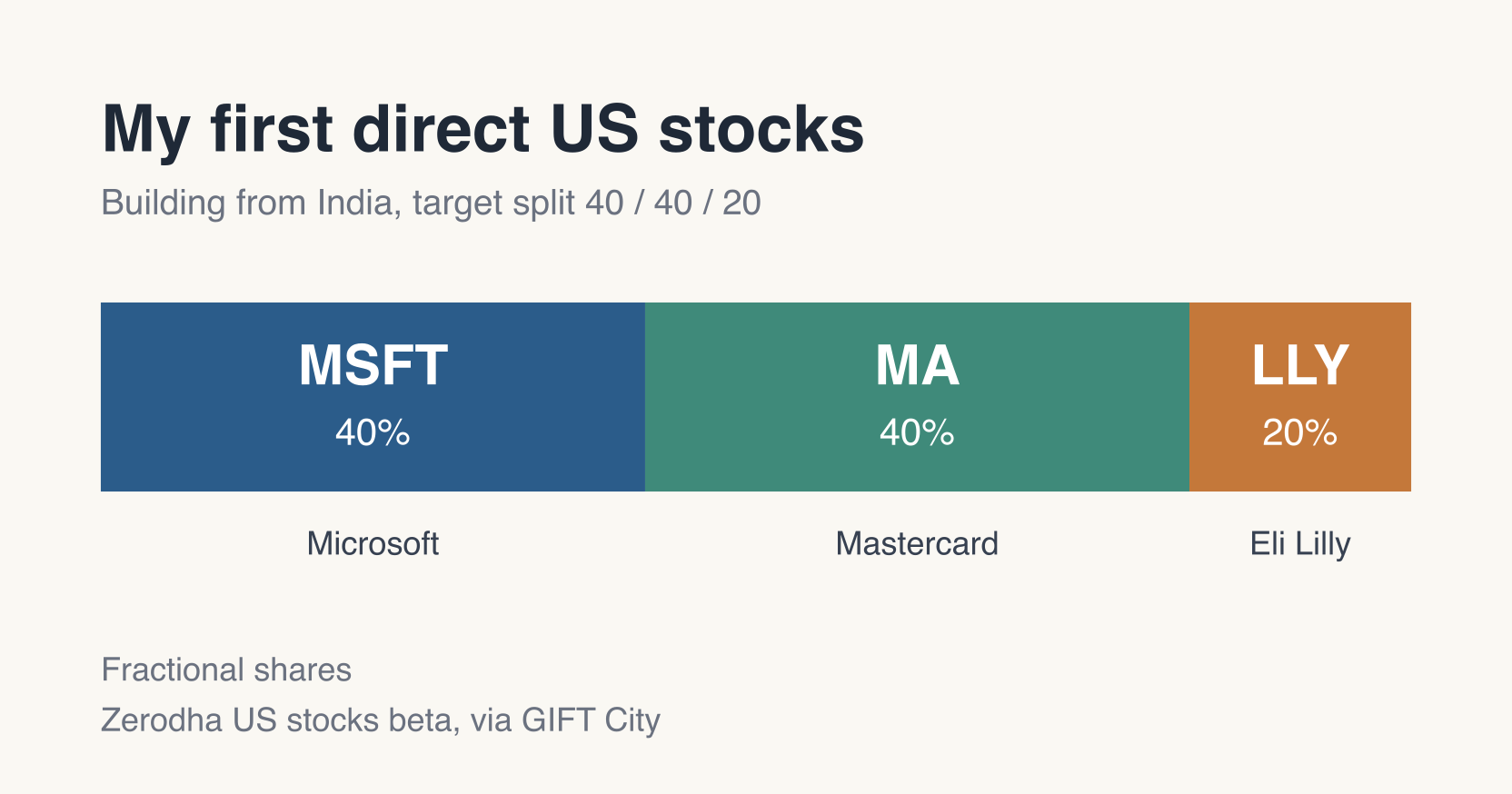
Until now I have had no foreign exposure at all, not even through feeder funds. My money has stayed entirely in Indian investments, and I want a small pocket of individual stocks outside that, holding a few global businesses directly. So today I placed my first order, for Eli Lilly (LLY). Microsoft (MSFT) and Mastercard (MA) will follow in the coming weeks as I build towards the split. This post covers how I decided what to buy and what I noticed along the way.
🔗Zerodha’s beta
Zerodha’s US stocks on Kite is in public beta, and accounts are switched on in batches. For eligibility, the sign-up steps, supported banks and charges, Zerodha’s global investing guide is the place to look. The announcement thread on TradingQnA has the questions other users are asking. Details may change while it is in beta.
One thing I am waiting for is UCITS ETFs, the Irish-domiciled funds that avoid the US estate tax issue I covered in the June post. The announcement says Zerodha is exploring them, and when a user asked for a timeline, a Zerodha reply in the thread said “1-2 months minimum”. If the time they took to launch global investing is a precedent, I would take that timeframe as six months minimum.
Funding happens inside Kite. You enter an amount in USD, authenticate through net banking (the only funding method, no UPI) with no additional paperwork. The money lands in a USD wallet, and Zerodha says it takes up to two working days if you start before 2:30 PM IST. In my case, I transferred the funds on Monday, bank debit happened on the same day and the money showed up in Zerodha wallet on Wednesday.
Among the list of supported banks, I had ICICI and Kotak linked to my demat account, wherein I found ICICI to offer better rate.
🔗What the remittance really costs
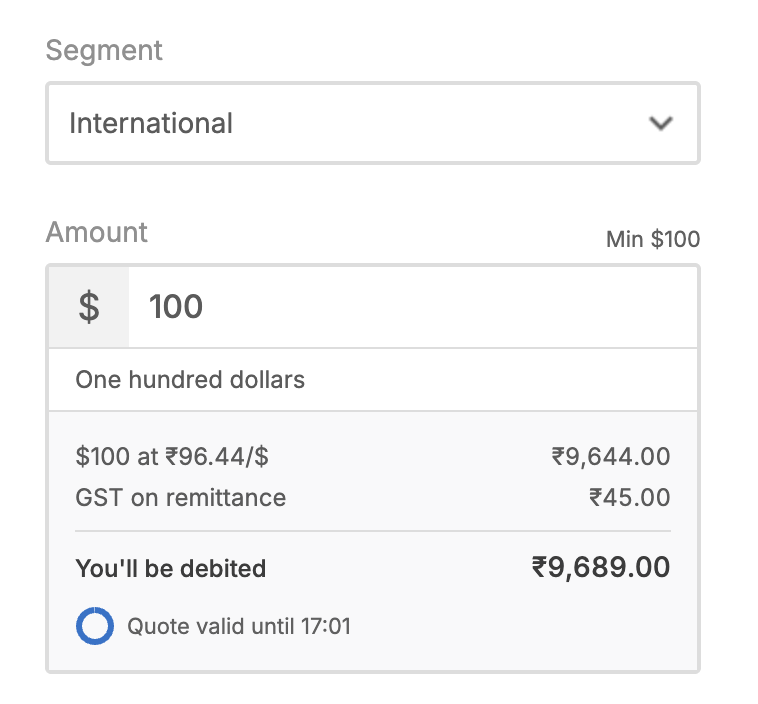
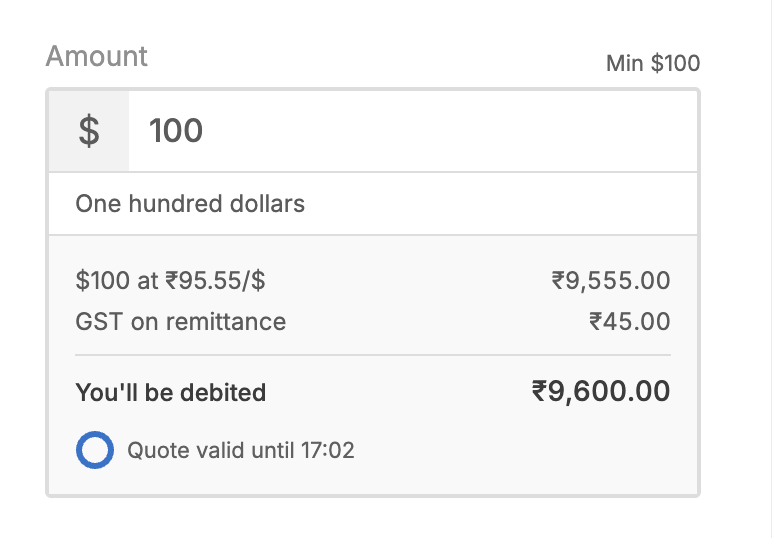
Kite shows the exact amount before you confirm. Enter the dollar amount and it displays the rate, the GST and the total you will be debited, with a quote that stays valid for a short time. I checked two banks today within a minute of each other - Kotak quoted ₹96.44 per dollar, so ₹9,689 all in for $100. ICICI quoted ₹95.55, so ₹9,600 for the same $100, about 0.9% cheaper. The quote is not final, though. When I funded my account on Monday through ICICI, the quote was ₹95.60 per dollar and the rate printed on the confirmation was ₹95.70, 10 paise higher.
🔗Picking three stocks that don’t overlap
The usual retail starter basket is Microsoft, Alphabet, Amazon and Apple, and more recently NVIDIA. True to Money Has No Memory, I decided to keep the stock count low and pick businesses from different industries with no overlap.
From that list I kept only Microsoft and added two businesses from other industries, splitting the money 40/40/20:
- Microsoft (40%). Enterprise software with high switching costs and recurring cloud and SaaS revenue.
- Mastercard (40%). A payments network that earns on transaction volume and does not lend, so it carries no credit-default risk.
- Eli Lilly (20%). Demand for chronic prescriptions.
🔗Why fractional shares matter
On Indian exchanges you buy whole shares. With US stocks you can instead buy by dollar amount and end up with a fraction of a share. Eli Lilly, for example, was about $1,266 a share when I placed my first order. Someone putting a modest amount away each month would sit on idle cash for months before affording even one share of it. Buying by amount removes that wait. Zerodha says you can start with as little as $1, though only in eligible stocks and ETFs, since not every instrument supports fractional quantities.
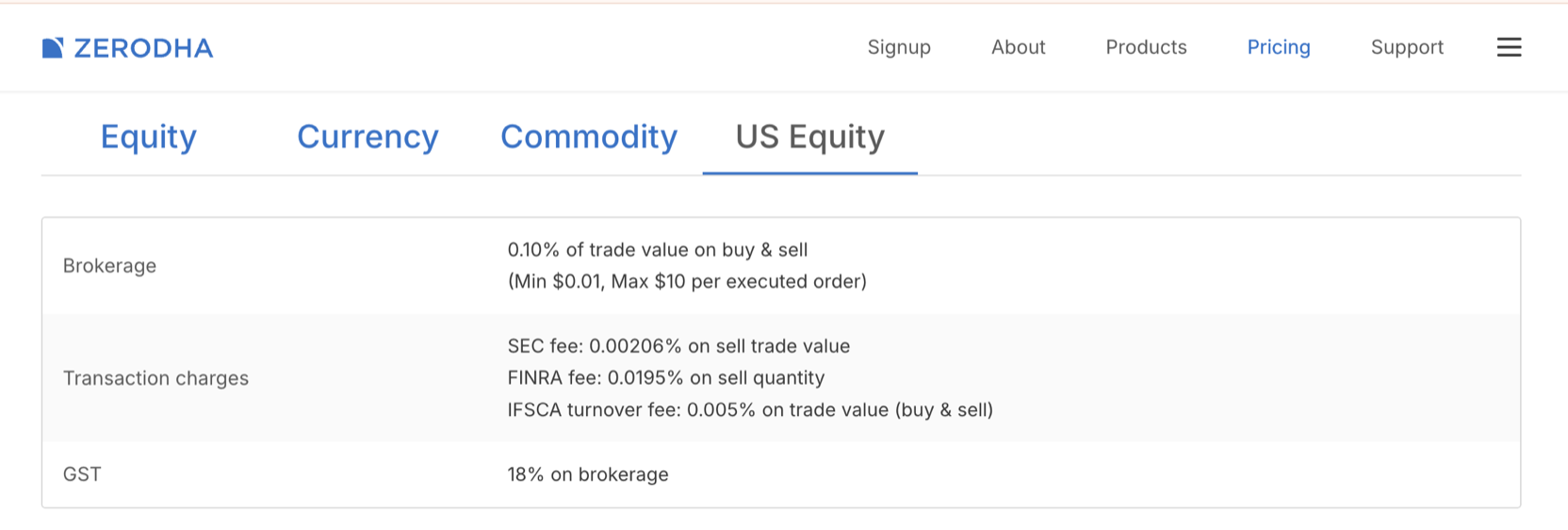
Zerodha executes orders only when the US market is open. In IST that is 7:00 PM to 1:30 AM while US daylight saving time is on (second Sunday of March to first Sunday of November), and 8:00 PM to 2:30 AM the rest of the year. Orders placed outside those hours wait for the open. My first order, for Eli Lilly, went in just before 8 PM IST and was completed.

🔗Tax and compliance
Zerodha’s guide covers this well, so here is the short version of what changes for me.
- You have to disclose the holding. Resident Indians must report foreign assets in the ITR (the foreign asset disclosure is called Schedule FA), even if there was no profit. It covers the US stocks and ETFs and any uninvested cash in the USD wallet. It follows the calendar year, January to December, not the Indian financial year, and skipping it can attract penalties. My October 2026 purchases will be reported in the filing next July.
- Gains are taxed only in India. Under the India-US tax treaty, capital gains on US stocks are taxed here and not in the US. If you hold for more than 24 months, the gain is long-term and taxed at 12.5% plus surcharge and cess, and the ₹1.25 lakh exemption on Indian equity does not apply. Anything shorter is added to your income and taxed at your slab rate.
- Claim the credit so dividends are not taxed twice. The US withholds 25% on dividends when a valid W-8BEN form is on file, and Zerodha issues a Form 1042-S each year showing what was withheld. Dividends are taxable in India as well, so to avoid paying twice you claim the US tax as a credit by filing Form 67 before the ITR. The credit is capped at the Indian tax due on that dividend. These three stocks yield only about 0.5% to 0.7%, so the amounts are small.
- Keep the paperwork handy. Zerodha’s Console provides a capital gains statement and a holding statement as of 31 December, which is what you need when filing. Fewer holdings means less to go through, which is one more reason I kept it to three.
🔗Verdict so far
I wish funding were quicker. Waiting up to two days feels slow when domestic investing runs on instant transfers, and it means I can’t act on a sudden, sharp dip. This is not really a Zerodha problem. The delay comes from the remittance itself: every transfer is an LRS remittance that the bank has to process and report to the RBI before the money reaches the wallet.
The reason I wanted foreign exposure is diversification. Everything I own is tied to one economy and one currency, and spreading across countries is the usual way to reduce that risk. The usual advice is to do it gradually and keep it a modest part of the portfolio, so I am starting in small bits instead of committing a large sum at once. Staggering also helps with the things I can’t control, like the exchange rate on the day and the price I buy at.
Three stocks are a start, not a diversified global portfolio. Broader exposure through index ETFs is where I expect to go next, and Zerodha already lists US-listed ETFs. The one thing I am waiting for is UCITS funds, for the reason covered above.
Disclaimer: This is my own log, not a recommendation to buy any stock. None of this is financial or tax advice. Please do your own research and consult a professional for your specific situation.