The AI Repatriation Cycle
Thomson Reuters just launched Thomson, its first proprietary large language model. Not a fine-tuned wrapper around GPT-5.5 or Claude. It’s a model the company owns outright, trained on its own compute, and it’s already live inside Tabular Analysis in CoCounsel Legal, reviewing up to 10,000 documents against up to 100 questions at once, with every answer traceable back to its source. It’s exactly the kind of high-volume, judgment-heavy review where a purpose-built model’s edge is measurable, not just claimed, and Thomson Reuters has said this is only the first rollout, with more of the product line expected to run on Thomson over time.
That’s the headline. The interesting part is why, and it’s a pattern enterprise infrastructure has run through before.
🔗We’ve seen this curve already
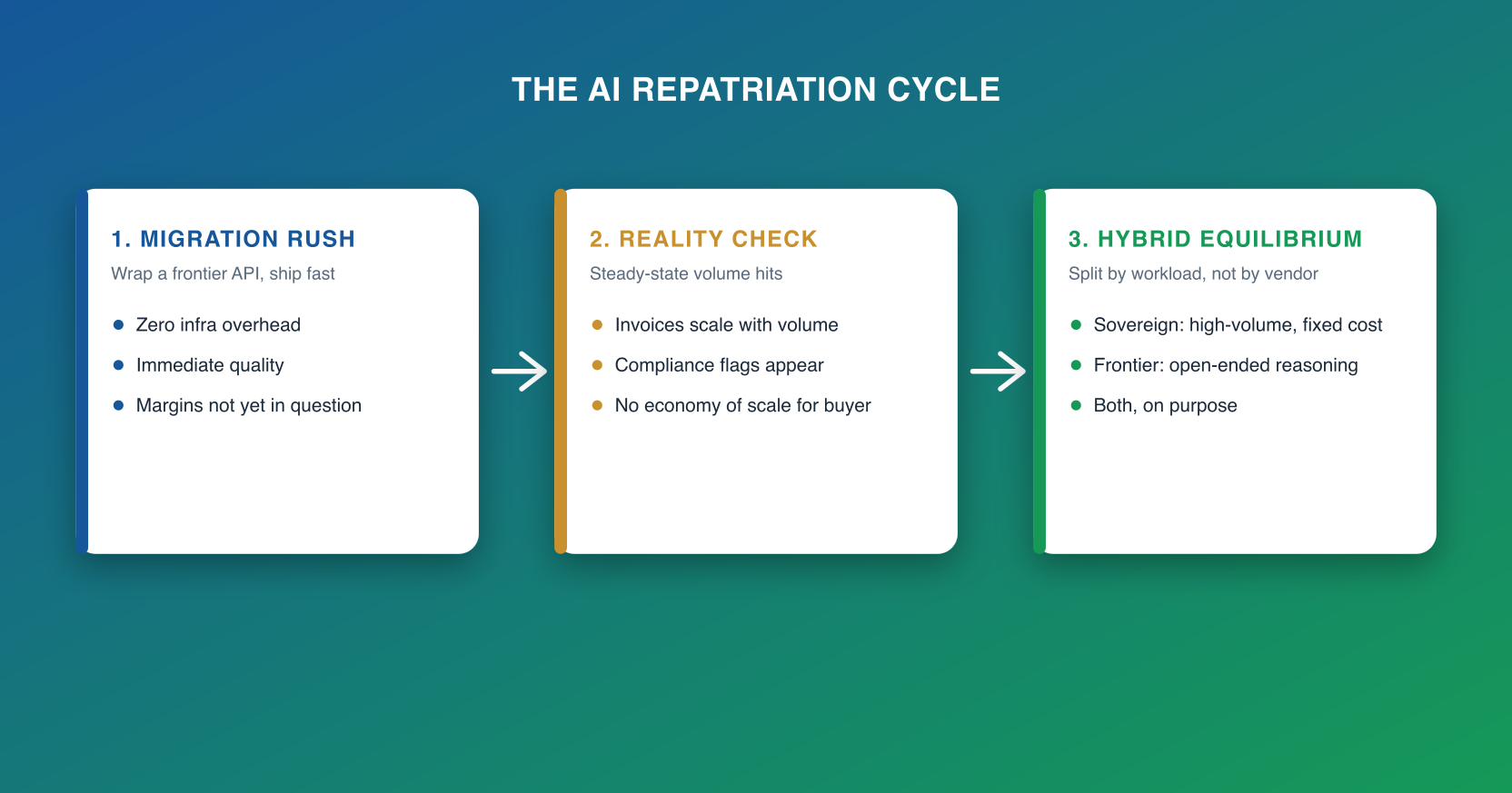
Early cloud adoption went through three phases:
- The migration rush. Move everything to public multi-tenant cloud for speed and zero infra overhead.
- The reality check. Steady-state scale hits. Monthly invoices balloon. Compliance flags start popping.
- The equilibrium. Workloads split. Elastic, unpredictable edge cases stay on public cloud. Core, high-volume, predictable workloads get repatriated to owned or dedicated infrastructure.
Generative AI is mirroring this step for step. 2023 to 2024 was the migration rush: wrap a frontier API, ship fast, worry about margins later. Thomson Reuters building its own model is the equilibrium phase arriving early, because the reality check hit faster this time than it did for cloud. Per-token pricing makes the invoice line painfully legible in a way that “our AWS bill is high” never quite was.
🔗The token toll vs. owned compute
Frontier APIs are unbeatable for prototyping: no infra, no ops burden, immediate quality. But the pricing model is linear, cost scales directly with volume, forever. There’s no economy of scale on the buyer’s side, only on the vendor’s.
Run the math on a realistic enterprise document pipeline: 100,000 documents a day, averaging 4,000 prompt tokens and 500 completion tokens each. That’s roughly 12,000 million input tokens and 1,500 million output tokens a month. Using Claude Sonnet 5 pricing as a frontier benchmark:
| Item | Volume | Rate | Monthly cost |
|---|---|---|---|
| Input tokens | 12,000M | $2/M | $24,000 |
| Output tokens | 1,500M | $10/M | $15,000 |
| Total | $39,000/mo ($468K/yr) |
A dedicated open-weight model in the 30B to 70B range, roughly the size class enterprises actually fine-tune, specialized on domain data and running on a reserved 8xH100 node, lands closer to half that, all-in. AWS’s own p5.48xlarge reserved pricing puts an 8x H100 node at $23.78 an hour on a 3-year commit, against roughly 730 hours in a month:
| Item | Detail | Monthly cost |
|---|---|---|
| 8x H100 node (reserved) | $23.78/hr x 730 hrs | $17,400 |
| Monitoring & control plane | flat estimate | $2,000 |
| Total | $19,400/mo (~$233K/yr) |
On-demand, the same node runs $55 an hour, which is the number that makes API pricing look cheap by comparison. Reserved is what makes owned compute pencil out. Same workload, about half the cost, and the number doesn’t move if volume grows.
That “about half” only holds at this volume, though. The self-hosted side is a fixed monthly cost whether you process one document or a million; the API side scales linearly with every document. There’s a specific volume where the two lines cross:
| Item | Value |
|---|---|
| API cost per document | (4,000 x $2/M) + (500 x $10/M) = $0.013 |
| Self-hosted fixed cost | $19,400/mo |
| Breakeven volume | $19,400 / (30.44 days/mo x $0.013) is about 49,000 docs/day |
100,000 documents a day is roughly double that crossover, which is why self-hosting wins by a comfortable margin in this example. Below about 49,000 documents a day, the fixed node costs more than just paying per token, and the API is the right call. That gap is why build-vs-rent stops being a philosophical question once you’re past pilot scale and becomes a straightforward FinOps decision.
Cost isn’t the only lever pushing that decision. Data residency does too: once a workload has to stay inside a specific jurisdiction, routing it through a vendor’s shared multi-tenant infrastructure raises a compliance question that a self-hosted cluster in your own region doesn’t. Thomson Reuters builds this in at the network layer rather than leaving it to contract language: their technical report describes a routing mesh that blocks residency-sensitive workloads from ever reaching a disallowed region, so a misconfiguration can’t accidentally send them there either.
🔗What Thomson Reuters actually built
Thomson Reuters didn’t train from scratch. It didn’t have to. The company spent roughly $40M over two years, mostly on personnel and compute, adapting Alibaba’s Qwen, an open-weight model, into an internal checkpoint it calls Snowdon, built jointly with Imperial College London to de-bias and harden it for professional use, then post-trained that on Westlaw and Practical Law content. The final training run itself cost about $450K. On benchmarks, the result is now competitive with frontier models from Anthropic, OpenAI, and Google on legal and general tasks.
A company whose entire pitch is sovereign, trustworthy, compliant AI for the legal profession built its core model on a Chinese open-weight base. That’s not really a contradiction. Open weights are commodity infrastructure now, and what Thomson Reuters actually controls is everything downstream of that checkpoint: the training data, the alignment process, the serving stack, the IP. It does mean sovereignty in this new AI stack is a narrower claim than the marketing implies. Nobody is re-deriving the base model from first principles anymore. The moat was never the weights. It’s what gets poured into them afterward.
The production model powering CoCounsel stays closed, but Thomson Reuters did publish a smaller research variant, Thomson-1.0-Small, as open weights on Hugging Face for academic and non-commercial use. Even the company making the sovereignty argument is routing some of it back out through the open ecosystem it started from.
🔗Where the real moat is
Raw compute and base model weights are commodities now. Anyone can rent GPUs, and anyone can start from an open checkpoint. What Thomson Reuters has that a competitor can’t replicate quickly is West Publishing’s 150-plus years of case law and legal content, the Westlaw and Practical Law platforms built on top of it, plus Checkpoint and the Reuters news archive. Thomson Reuters says it trained on less than 10 percent of that content so far, and none of it has to touch a third-party training set.
That’s the actual lesson for anyone doing this at enterprise scale: the defensible asset was never “we have an AI model.” It’s the proprietary corpus and the human feedback loop that goes into specializing it. That’s the same thing that made a company’s core database or ERP defensible a decade ago, just applied to model weights instead of schemas.
🔗The hybrid topology, not an either/or
None of this means abandoning frontier APIs. It means routing: a gateway in front of the app layer decides per request whether a task goes to a dedicated, fine-tuned model or out to a frontier API mesh. That’s an architectural recommendation, not a description of what Thomson Reuters has built. Their own infrastructure section documents something narrower: a routing layer that picks among their own self-hosted clusters for failover and data residency, not a classifier deciding sovereign versus frontier per query.
Cloud didn’t kill private infrastructure. It produced hybrid cloud. AI is heading toward the same split: frontier APIs handle unstructured reasoning and the long tail of edge cases, while dedicated models handle the high-volume, deterministic, compliance-sensitive core.
Thomson Reuters is already living this. Their own technical report says their self-hosted inference platform has served more than 40 million requests and processed 370 billion tokens since April 2026, and that self-hosting GLM-5.2 saved 19.7 percent versus third-party inference providers. The report names the reason plainly: managed vendor offerings carry a long-term risk of lock-in, with no clear exit strategy if costs rise. And despite building and launching Thomson, they kept their Anthropic contract running for other workloads rather than cutting over entirely. The point was never to replace the frontier API mesh. It was to stop paying the token toll on the volume that didn’t need it.
🔗What this means if you’re making this call
- Audit the workload, not the org. Split AI usage into deterministic, high-volume tasks (candidates for a dedicated or open-weight model) versus open-ended reasoning (stays on frontier APIs).
- Find your breakeven volume. Model your actual token spend against a reserved GPU node’s cost. In this post’s example that crossover lands around 49,000 documents a day; below it, APIs win outright. There’s no universal crossover point, yours will depend on your own token profile and hardware pricing, but the fixed-cost-versus-per-token shape is always the same.
- Treat your proprietary corpus as the actual asset. The fine-tuning data and feedback loop are what’s defensible, not the base weights or the infrastructure.
- Put a gateway between your app and the model. Abstracting the endpoint is what lets you move workloads between sovereign and frontier without a rewrite later.
The benchmark leaderboard chase was never the differentiator. What matters is owning a cost-controlled, domain-specialized inference stack, and knowing exactly which workloads belong on it.